
Staffing optimization cycle compressed from months to ~1 week
Full-time and float-pool nurse balance optimized against forecast demand
Patient demand forecast and schedules generated across departments and nursing units

A leading healthcare consulting and performance analytics firm needed a more efficient way to optimize hospital staffing for its clients. Workforce planning depended on manual scheduling work that was time-consuming, hard to scale, and ill-suited to balancing patient demand against financial constraints.
The result was suboptimal staffing levels, higher labor costs, and an administrative burden that grew with every new engagement. The firm wanted to shorten the consulting cycle and put a more rigorous, data-driven optimization process in the hands of its analysts.
OneSix designed and built a staffing optimization tool that combines patient demand forecasting with scheduling optimization in a single workflow. The tool ingests historical healthcare data alongside external public sources to forecast patient demand across departments and nursing units, giving the firm a quantitative basis for every staffing recommendation.
A simple web interface lets analysts input unit-specific financial and scheduling constraints, including budget limits, full-time versus float-pool nurse mix, and department-level rules. The optimization engine combines linear programming with evolutionary algorithms to generate multi-week rotating schedules that meet forecasted demand at the lowest cost, balancing department-specific staff against higher-cost float-pool nurses.
The tool reduces a months-long consulting engagement to roughly one week of analyst work, gives client hospitals precise staffing adjustments tied to forecasted demand, and provides the firm with a scalable, data-driven foundation it can apply across multiple hospital departments and clients.
More to explore

OneSix created a Power BI solution for a global restaurant chain, enabling interactive, on-demand insights into sales performance and customer sentiment across international markets.
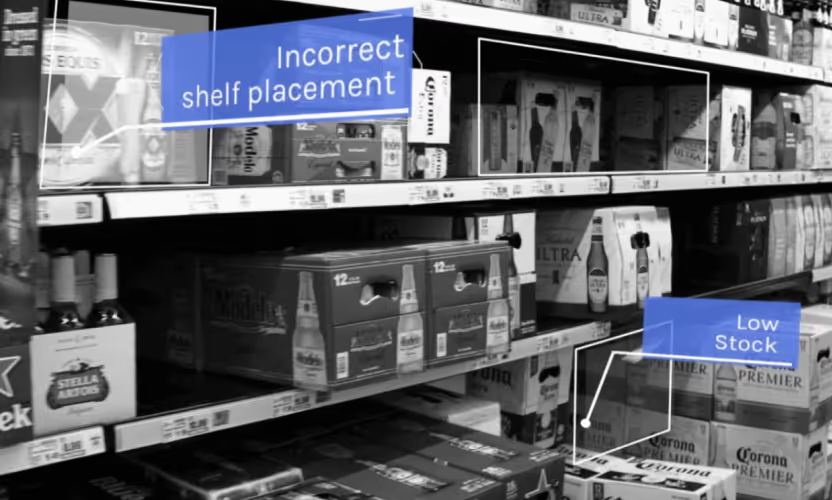
OneSix designed and implemented a computer vision-based product identification pipeline capable of rapidly identifying products on grocery store shelves.

By analyzing and adjusting data processing schedules, OneSix enabled a seaside amusement park to significantly reduce unnecessary cloud expenses while maintaining scalability during peak demand. This optimization improved cost efficiency and ensured the pipeline aligned with real-time business needs.