
We build, train, and operate forecasting systems that combine deep learning with statistical methods, run at the scale your data requires, and retrain themselves as patterns shift.
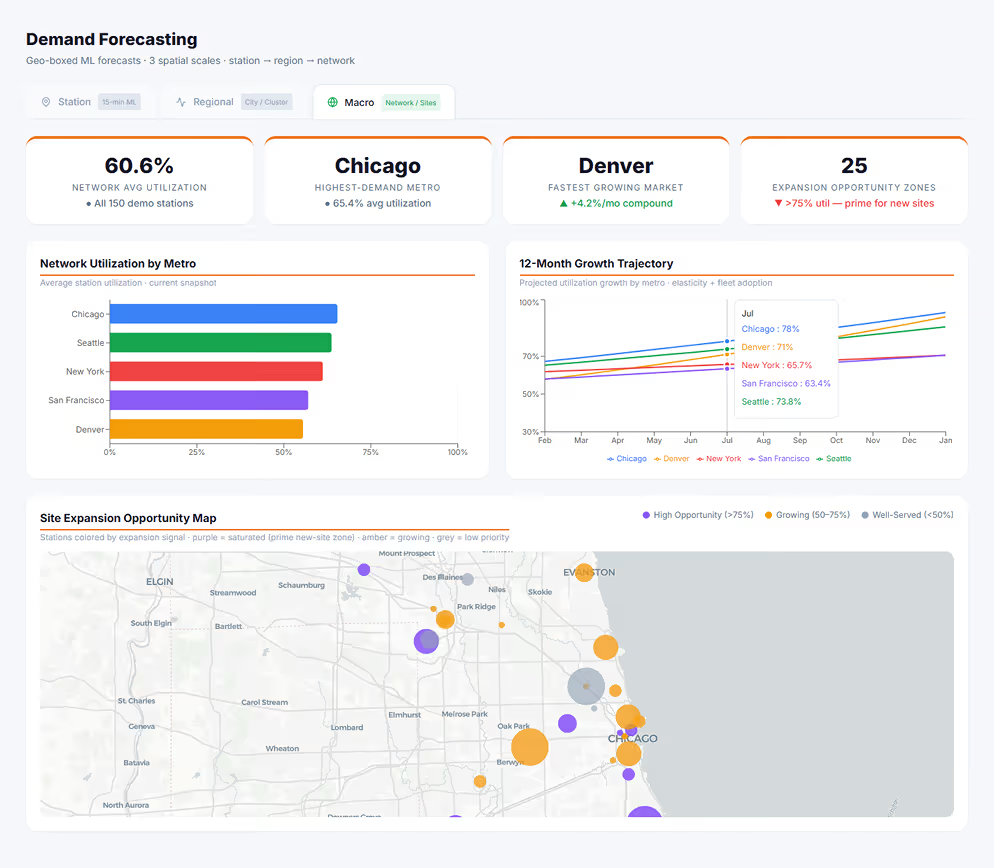
Multi-scale ML forecasting with a live what-if engine for demand, congestion, and pricing.
CHALLENGES
Most planning processes are built on forecasts that no longer describe current conditions. Spreadsheets cap the scale, refresh cycles lag the data, and models trained on history stop predicting the present.
Spreadsheet-based forecasting breaks down at volume. As the number of time series and variables grows, accuracy drops and the model becomes impossible to maintain.
By the time a quarterly or monthly forecast is produced, the inputs it was built on have already moved. Planning catches up to reality after the cycle is over.
Models trained on historical data don't adapt to shifting demand patterns, new seasonality, or market volatility. Accuracy quietly degrades until someone notices the variance.
When forecasts miss often enough, leadership hedges. Budgets get padded, decisions stall, and the planning process loses authority across the organization.
Approach
We build forecasting systems that combine statistical, autoregressive, and deep learning methods to handle the scale and complexity your data requires. One priority forecast is validated against historical outcomes and deployed into your planning workflow within the first sixty days.
01
Multi-method modeling across statistical, autoregressive, and deep learning approaches
02
Backtesting and validation against historical outcomes before deployment
03
MLOps infrastructure that retrains models as patterns shift and new data arrives
04
Integration into the planning tools and workflows your team already uses

The output is a production forecasting system your team can run, trust, and refresh as conditions change, along with the modeling and MLOps practices that make every subsequent forecast faster to build and easier to maintain.
Jacob Zweig
Managing Director, AI
Applications
Variant
Built for
Variant
Built for
Manufacturing and supply chain teams aligning production and inventory to actual demand signals
Variant
Built for
Manufacturing, utility, and transportation teams forecasting equipment failure and scheduling service before downtime occurs
Variant
Built for
Higher ed teams projecting enrollment, identifying retention risk, and informing staffing and budget decisions
Variant
Built for
Healthcare teams planning staffing, capacity, and resource allocation against anticipated patient demand
Variant
Built for
Pharmaceutical and life sciences teams aligning production, distribution, and inventory to clinical demand signals
Variant
Built for
Operations, finance, and risk teams flagging process drift, fraud signals, and outliers as they occur
Variant
Built for
Marketing and revenue teams projecting pipeline, growth, and customer behavior
Accelerator
For organizations ready to move beyond spreadsheet forecasting, we deploy the Forecasting Accelerator, a production-ready forecasting system built on TorchCast, OneSix's open-source PyTorch-based forecasting library.
What's included
OneSix's open-source PyTorch-based forecasting library, combining classical statistical methods with deep learning. Battle-tested across transit, supply chain, financial planning, and more.
Forecasts related metrics simultaneously while incorporating seasonality, weather, holidays, and other factors that shape the conditions a forecast is meant to predict.
Every forecast ships with confidence intervals and quantified driver contributions, so teams understand how each factor influences the result.
Trained models, inference infrastructure, and monitoring deployed in your environment, scaled to hundreds or thousands of concurrent forecast series.
Process
01
Data audit and forecast use case selection
02
Framework configuration and model training against historical data
03
Backtesting and calibration against held-out outcomes
04
Production pipeline, monitoring, and handoff
FAQ


Revenue and pipeline, demand and inventory, enrollment and retention, patient volume, drug demand, predictive maintenance, and anomaly detection are the most common. The modeling approach is selected based on your data environment and the forecasting horizon required.
Traditional models like ARIMA work well for simple, stable time series. Deep learning approaches handle much higher complexity: multiple variables, non-linear relationships, and large numbers of simultaneous time series. Most of our deployments combine both, applying statistical methods where they perform well and deep learning where complexity warrants it.a
It depends on the forecasting horizon and the variability of what you're predicting. More history generally improves results, but we assess what you have during scoping and design the model architecture around it.
Every engagement includes MLOps design and model monitoring. We build the retraining triggers and performance tracking that keep forecasts accurate as patterns shift and new data arrives.
A sixty-day initial phase. Inside that window we agree on the priority forecast, prepare the data, select and validate the model, and deploy it into your planning workflow. The patterns set during that build (modeling approach, monitoring triggers, retraining cadence) carry forward to everything that follows.