
With marketing efforts spread across countless channels, each dollar spent—and each customer touchpoint—has greater impact and complexity.
Unfortunately, many brands still rely on outdated marketing models: last-click attribution, rigid budget plans, and disconnected reporting systems. These traditional approaches can’t capture the full story, leading to missed opportunities and wasted spend.
It’s time to move beyond guesswork. With the rise of AI-powered tools like Multi-Touch Attribution (MTA) and Media Mix Modeling (MMM), brands can now track the complete customer journey, attribute value across every channel, and continuously optimize their marketing strategy in real time.
In this post, we’ll explore how AI is reshaping marketing strategy—from smarter budget allocation to advanced attribution models—and how OneSix can help you turn insights into impact.
Many marketing teams still rely on legacy models—last-click attribution, manual reporting, and siloed channel analysis. These outdated methods make it nearly impossible to understand the full customer journey or justify budget allocation decisions.
In a world where customers interact with brands across multiple devices, platforms, and stages of decision-making, traditional marketing approaches simply can’t keep up.
AI models can analyze historical performance, campaign goals, and channel effectiveness to recommend how to allocate your marketing budget across platforms like Google Ads, social media, email, and display. Instead of relying on static budgets set months in advance, AI enables dynamic, responsive decision-making—so you're always investing where it counts.
See the full picture of the customer journey.
Understanding the effectiveness of your marketing efforts is no small feat—especially when customer journeys span a wide array of online and offline channels. That’s where Multi-Touch Attribution (MTA) comes in.
MTA is a powerful framework that helps marketers understand how different touchpoints—like social media ads, search campaigns, email marketing, and website visits—contribute to a customer’s decision to buy or engage. Unlike basic models that assign all the credit to the first or last interaction, MTA assigns value to multiple touchpoints across the journey, providing a more accurate, data-informed view of marketing performance.
Before diving into advanced techniques, it’s helpful to understand where many marketers start:
While easy to implement, these models often produce incomplete or misleading insights, especially when trying to optimize spend across diverse marketing channels.
As marketing channels become more complex and customer journeys more fragmented, modern AI-driven models are filling the gap. Advanced MTA approaches—like LSTM networks, Transformers, and Temporal Convolutional Networks (TCNs)—can model sequential customer behavior, learn from historical data, and accurately assign value to each touchpoint.
So how do these models translate into better business outcomes?
Our work in action → Scaling multi-touch attribution to optimize pharmaceutical marketing impact
Once an MTA model is trained, it produces attribution weights that quantify each touchpoint's influence on conversions. These weights can be used to solve a mathematical optimization problem: how to distribute your marketing budget across channels to maximize conversions or revenue.
For example, if your MTA model outputs these weights:
You can use optimization techniques (e.g., linear programming or gradient descent) to allocate your budget in a way that maximizes return, while also considering constraints like minimum spend thresholds or strategic goals.
OneSix helps brands take these results and apply them in the real world—building automated budget optimization systems that adjust spend in real time based on performance data and predictive insights.
Optimize every marketing dollar you spend.
In today’s privacy-conscious environment, Media Mix Modeling (MMM) is gaining traction as a powerful, cookie-free approach to understanding marketing impact.
MMM uses aggregated historical data to quantify how different marketing activities—like TV, paid search, influencer campaigns, or email—affect outcomes like revenue, conversions, or customer lifetime value. It’s especially valuable when dealing with long buying cycles, offline conversions, or regional campaign variations.
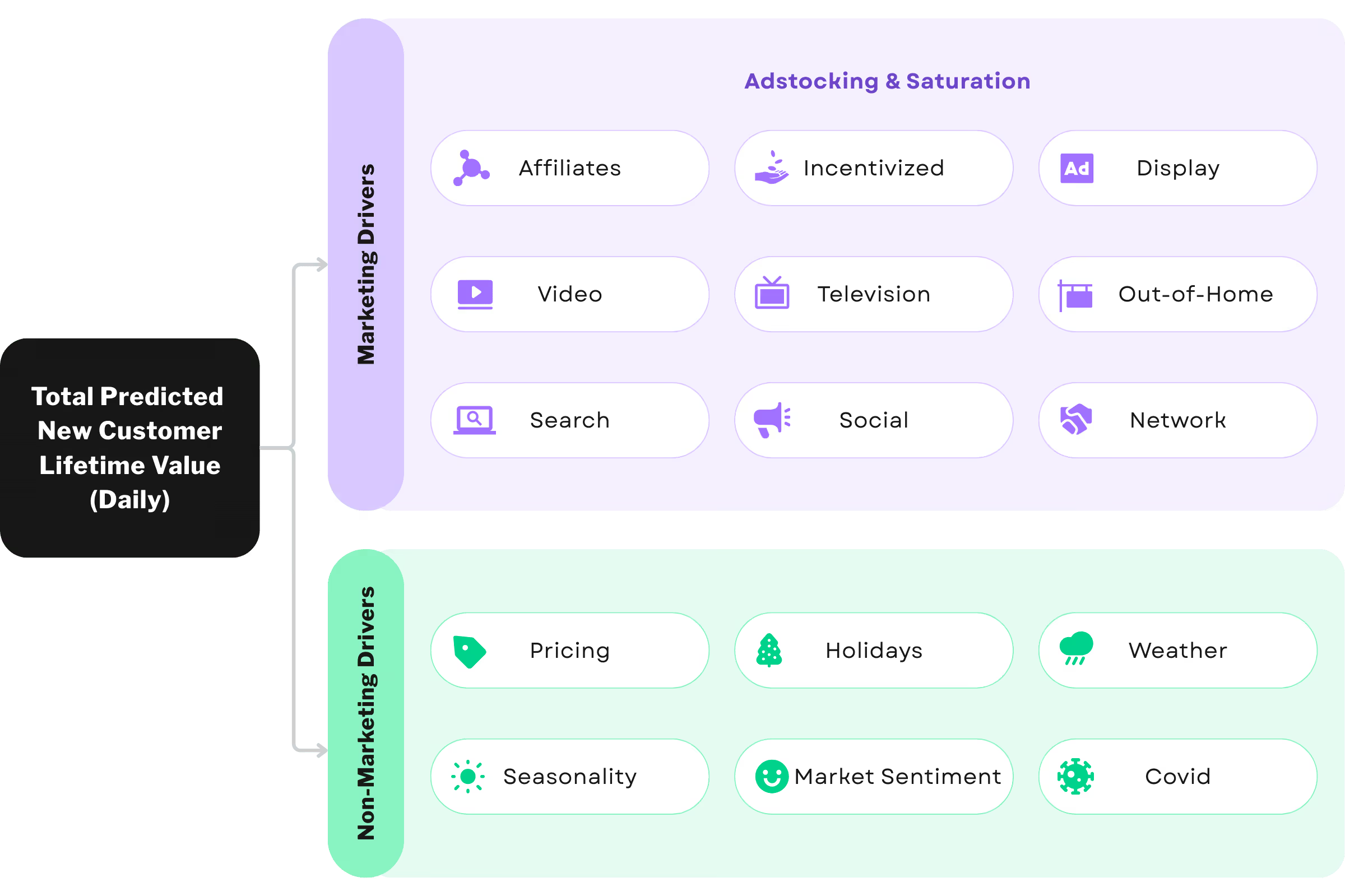
As marketing strategies grow more complex, so does the challenge of proving ROI. MMM addresses this by offering:
Our work in action → Building a forecasting engine and media mix modeling pipeline for a FinTech firm
MMM builds a statistical model that connects marketing activities and external factors to your key business outcomes. Here are two of the most important concepts:
Not all marketing effects are instant. Adstocking accounts for the delayed impact of a campaign—for example, the lingering effect of a billboard or a TV commercial. This allows the model to recognize how impressions continue to influence behavior days or weeks after the initial exposure.

Every channel has a point of diminishing returns. MMM models use saturation curves (often modeled with a Hill function) to understand when added spend in a channel stops yielding proportional returns. This is crucial when planning budgets across multiple media types with vastly different spend efficiency curves.
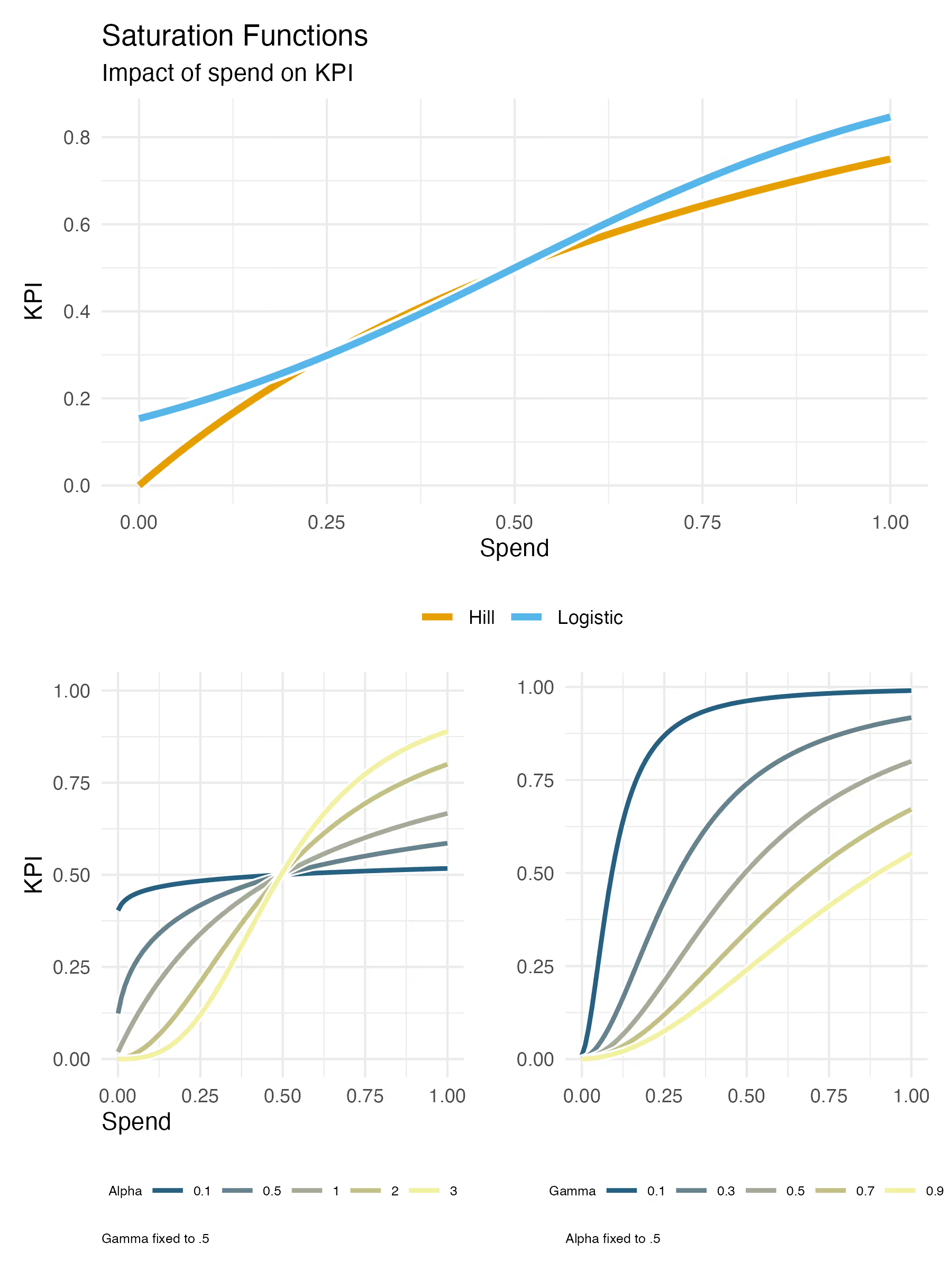
MMM also adjusts for external factors like pricing, market conditions, and seasonality—ensuring you isolate marketing's true impact.
There are a number of tools available to implement MMM—each with its strengths and trade-offs.
For brands with unique needs—such as regional campaign structures, legacy data systems, or complex business rules—a custom MMM model may be the best route. These models offer:
OneSix partners with clients to design and implement bespoke MMM solutions, from initial data exploration through production-ready deployment—ensuring that the model aligns tightly with your business goals and marketing operations.
Once an MMM model is built, it generates a set of channel-level performance metrics—like marginal ROI and efficiency curves. These metrics feed directly into budget optimization models, helping you decide how much to spend on each channel to maximize ROI, given your total budget and business constraints.
Example:
Using these inputs, OneSix can help you solve for the optimal budget allocation using methods like linear programming or Bayesian optimization—automating the process of getting the most out of your spend.
Our work in action → Boosting sales by 15% through marketing optimization for a spa franchise