CHALLENGES
The pattern repeats across industries. Cameras, scanners, and sensors capture more than any team can review, and the most expensive failures hide in that gap.
Manual inspection of images and video breaks down at volume. Accuracy drops and cost climbs faster than headcount can absorb.
The defect, the safety incident, the equipment failure. Each is cheaper to catch as it happens than to address downstream. Most operations still find out too late.
Most enterprises produce more visual data in a day than their teams can review in a year. The footage is stored. The intelligence inside it is not.
Two trained operators looking at the same image can reach different conclusions. The variance shows up as a quality, compliance, and defensibility risk that a consistent decision rule resolves.
Approach
We build vision systems trained on domain-specific data and optimized for the environment where inference happens.
01
Object detection, classification, and segmentation
02
Annotation, augmentation, and synthetic data pipelines
03
Architecture tuned to latency, accuracy, and memory budget
04
Edge, cloud, or hybrid deployment wired into existing workflows

The output is vision models your team can operate and extend, along with the data infrastructure, training environment, and operational practices that make subsequent builds shorter and cheaper than the first.
Jacob Zweig
Managing Director, AI
Applications
Variant
Built for
Variant
Built for
Manufacturers confirming assembly, finish, and tolerance compliance at line speed
Variant
Built for
Industrial operators catching surface, structural, and process anomalies before shipment
Variant
Built for
Operations and safety teams flagging hazards, PPE compliance, and unsafe behavior in real time
Variant
Built for
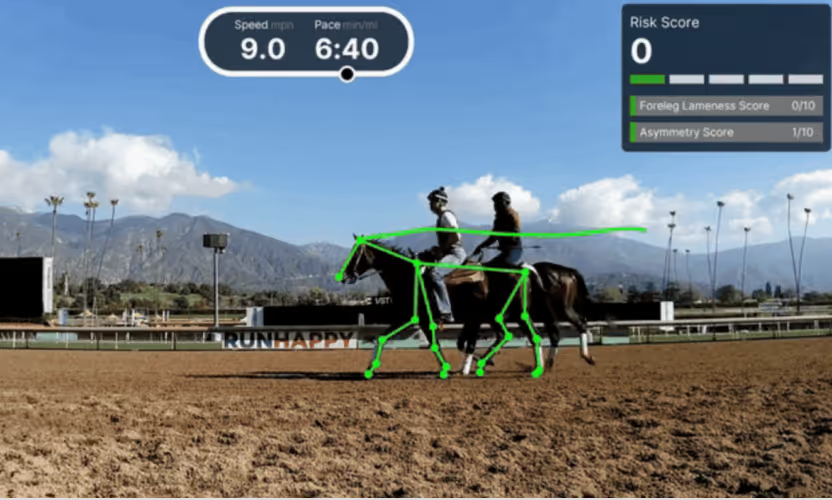
Teams quantifying movement, posture, or sequence across sports, workforce, healthcare, and animal monitoring
Variant
Built for
Healthcare and life sciences teams accelerating diagnostic workflows, image triage, and clinical research
Variant
Built for
Agriculture, retail, and supply chain operators automating physical counts
FAQ


Less than most teams assume. A few hundred to a few thousand carefully chosen examples per class is often enough to begin, with augmentation, synthetic data, and pretrained backbones closing the rest of the gap. What matters is that the labels represent the conditions you expect in production.
Usually, yes. Most vision systems can be built on existing camera feeds and storage. We assess what is in place during scoping and only recommend new hardware when the workload requires resolution, frame rate, or sensor types the existing setup cannot deliver.
Models drift. Lighting shifts, equipment ages, targets evolve. Our deployments include drift monitoring that flags when inputs or outputs move outside acceptable ranges, plus a retraining loop that feeds reviewed cases back into the model so accuracy holds over time.
Latency, cost, and connectivity drive the choice. Edge fits real-time use cases and low-bandwidth sites. Cloud fits heavier offline analysis. Hybrid runs detection at the edge and analytics in the cloud. We pick the configuration the workload requires.
Most use cases do not require identifying individuals, so we default to anonymized outputs (counts, postures, trajectories) rather than recognizable footage. Where identification is required, the system operates within regional regulation such as GDPR, HIPAA, and BIPA, with retention controls and audit trails engineered in.
.avif)