
Most agent demos look the same: one capable LLM, a handful of tools, and a happy-path workflow that works–once. Maybe even a few times. Then it gets shown to stakeholders and the question becomes: can we ship this?
This is where most teams get stuck.
The gap between a compelling agent demo and a production-ready agentic system isn’t about prompt quality or model choice. It’s about systems design. In production, an agent is not a clever script–its a distributed, stateful system that must be repeatable, observable, secure, and cost-bounded while operating under uncertainty.
The prototype mindset optimizes for capability: can the agent do the thing?
The production mindset optimizes for reliability: can the system do the thing a thousand times a day, across teams, without surprises?
Nearly every production decision for agentic AI falls into three buckets:
Choosing an agent design pattern is a structural decision guided by the business objective and determines your system’s failure modes, debuggability, and operational burden. Throughout 2025, the community shifted away from “monolithic” prompts toward specialized multi-agent coordination. By breaking complex tasks into discrete roles, your system can achieve higher reliability and easier maintenance.
Below, we explore four common patterns of agentic architecture, moving from rigid structured workflows to highly decentralized systems, before examining the specific role–and risks—of the single-agent model.
The supervisor agent plans tasks, delegates to tools or sub-agents, and aggregates results.
Best for: workflows that must be predictable, auditable, and easy to reason about
Tradeoffs:
This pattern maps cleanly to traditional workflow engines and is often the easiest to productionalize.
Customer Support System
A triage agent receives a support ticket, classifies the issue type (network, billing, access), and routes it to the appropriate specialist agent. The triage agent doesn’t handle the ticket itself–it decides which expert to consult. This mirrors human support centers where a receptionist routes calls to technical support, billing teams, and account management.
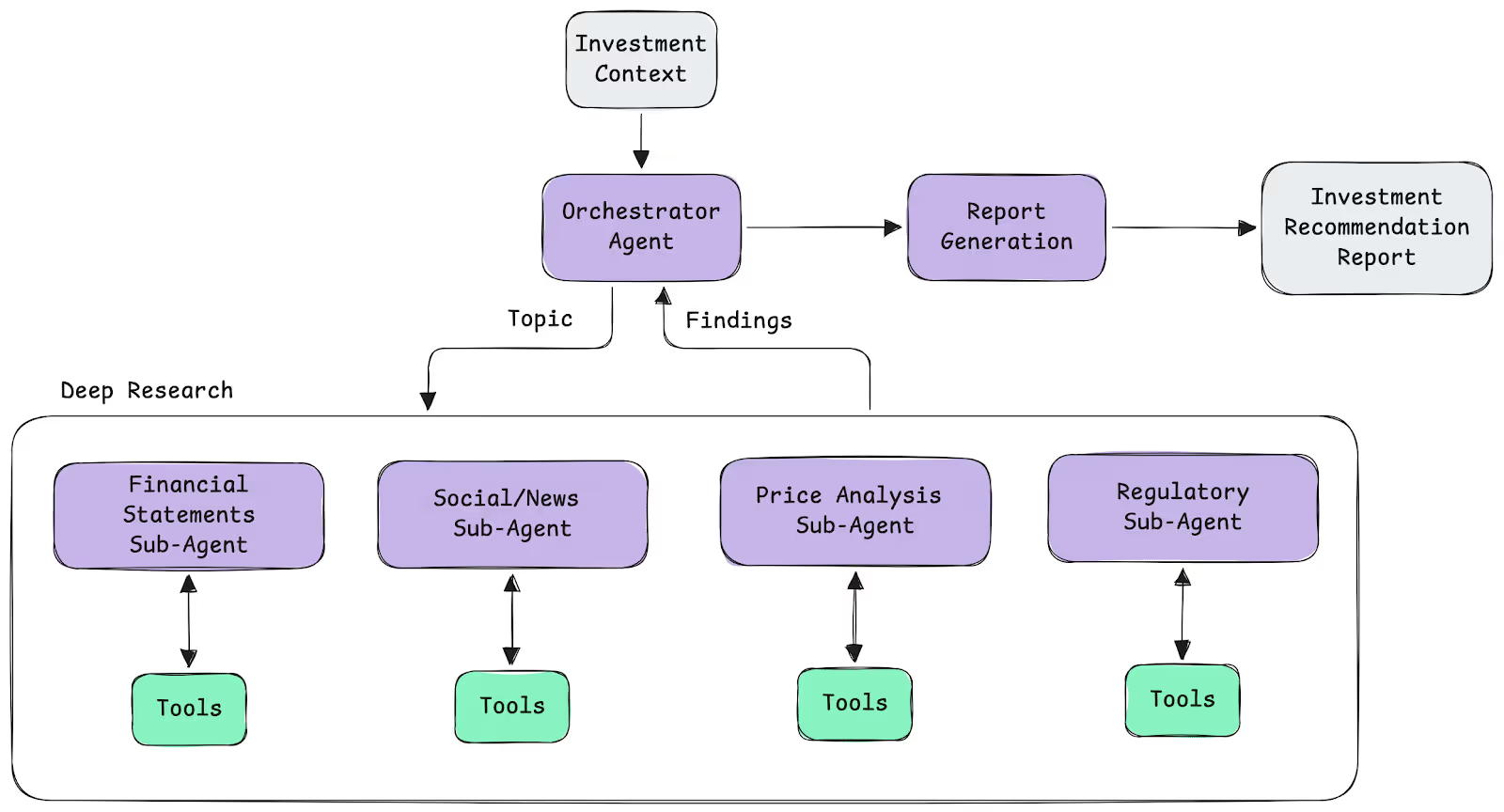
Multi-Agent Investment Analysis
A coordinator agent receives a ticker symbol and dispatches it to four parallel specialist agents simultaneously–fundamental analysis (financial statements), technical analysis (price patterns), sentiment analysis (news/social signals), and ESG evaluation. The coordinator aggregates their independent insights into a single investment recommendation.
A fixed sequence of specialized agents (e.g., retrieve → analyze → decide → act).
Best for: well-defined business processes like document extraction, intake triage, or approval flows.
Tradeoffs:
This pattern shines when the business process already exists and the agent augments it, rather than replaces it.
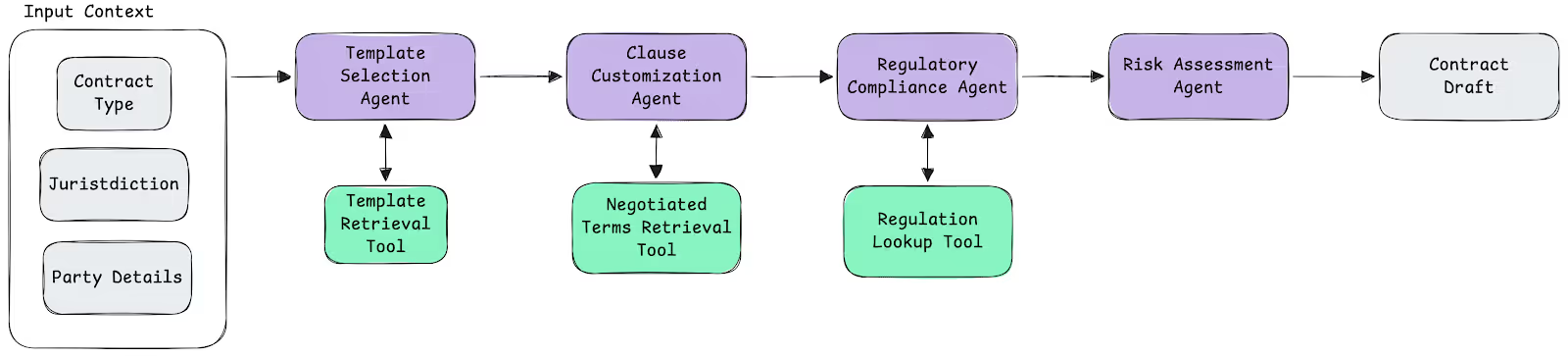
Contract Draft Pipeline
A law firm’s document system chains four agents in sequence:
Agents subscribe to events and react asynchronously (ticket created, invoice posted, alert fired).
Best for: high-volume operational environments where agents augment existing systems
Tradeoffs:
This pattern treats agents as probabilistic microservices–powerful, but operationally demanding.
Self-Healing IT Infrastructure
When system logs and metrics arrive via Kafka topics, multi AI agents respond in parallel without explicit orchestration:
Each agent subscribes independently to the same event stream. No centralized coordinator decides which agent should act–they all react based on their internal logic.
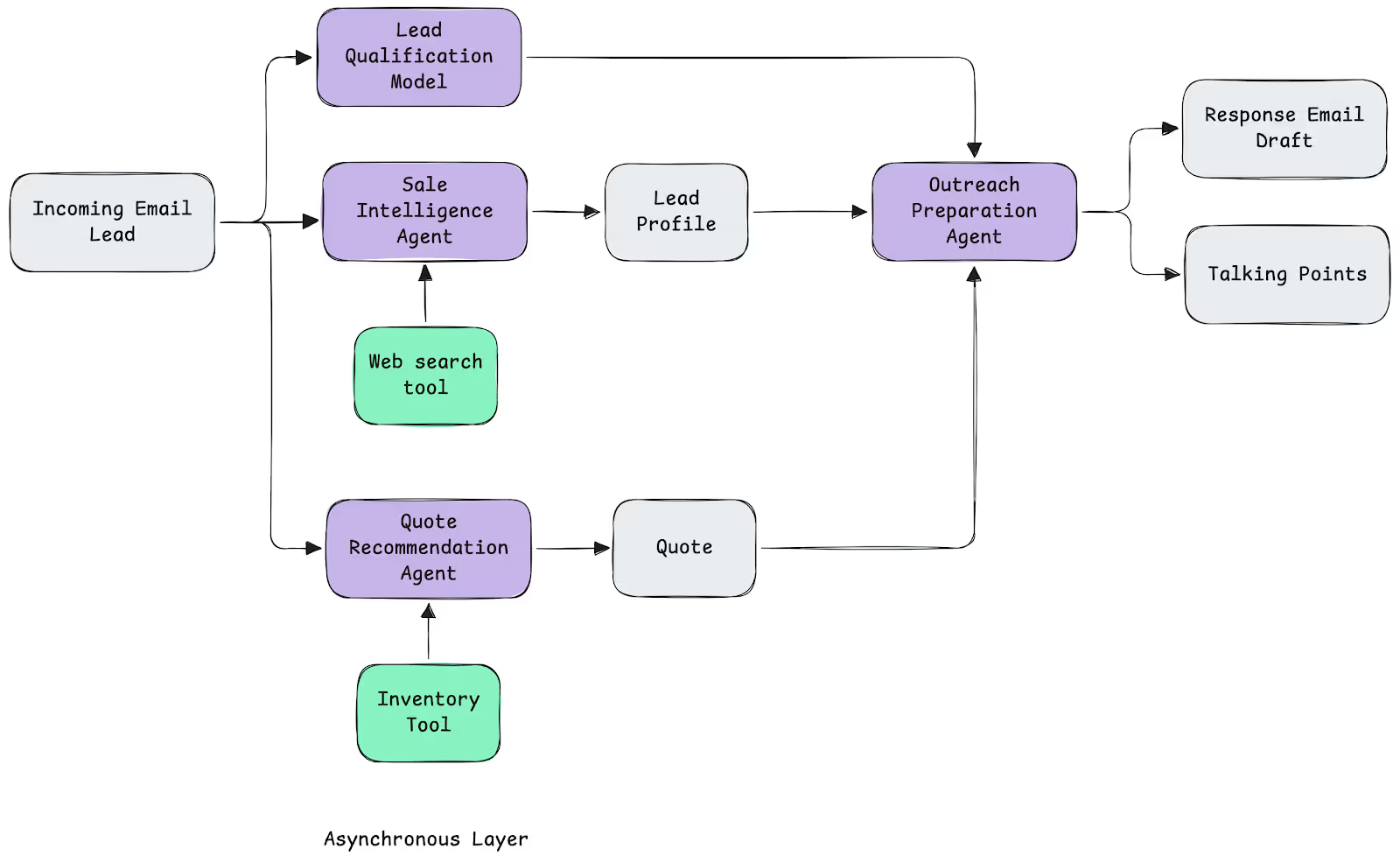
Lead Intelligence for Sales Teams
When new lead emails arrive in the inbox, multiple agents react asynchronously to enrich the opportunity:
All execute concurrently without blocking the email system. By the time a sales rep opens the lead, they have a complete intelligence package—prospect research, competitive context, recommended quote positioning, and talking points—dramatically shortening sales cycles.
One agent with many tools and an ever-growing prompt.
Best for: proofs-of-concept, demos, and narrow use-cases
Reality: while often the starting point for developers, this pattern faces a fundamental scaling wall as workloads grow in complexity.
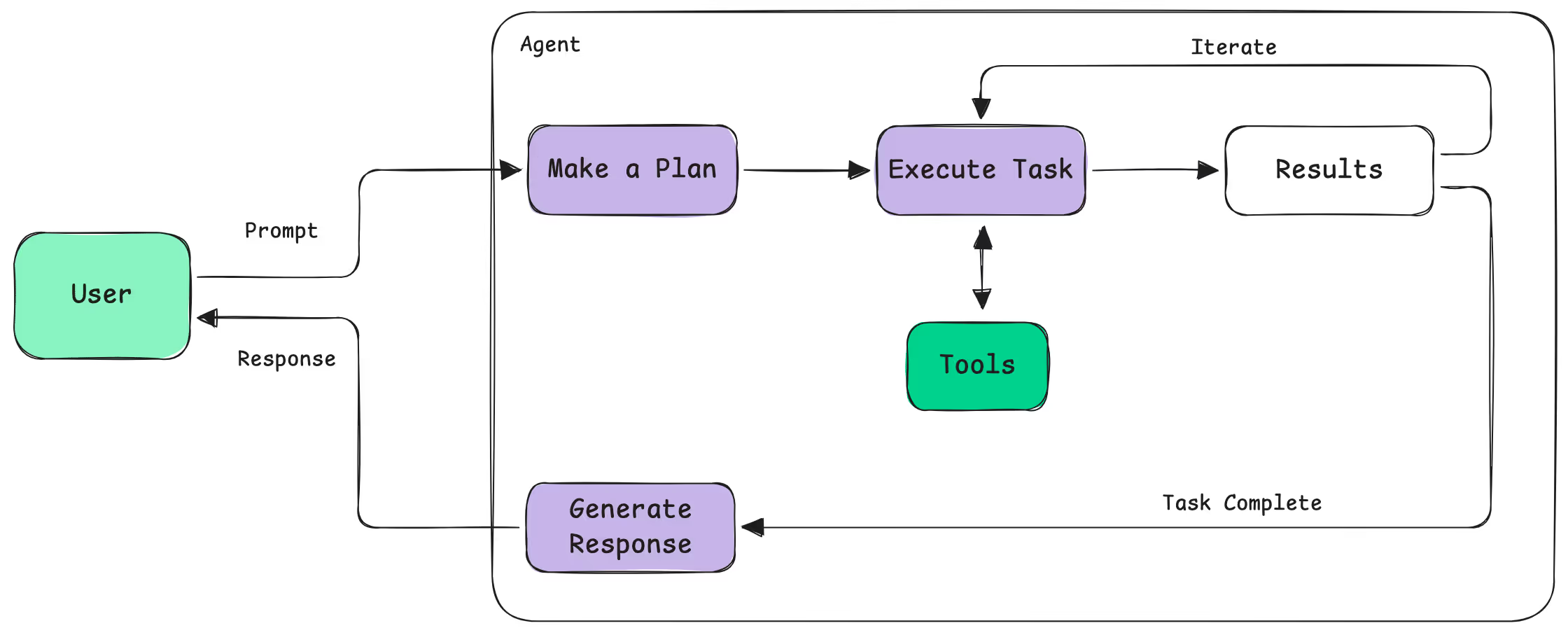
Coding Assistants and Platform Copilots
The single agent pattern works well in constrained domains like basic coding assistants or platform copilots—they operate synchronously, reasoning through tasks, and have a defined set of tools and actions. However, once behavior becomes complex, debugging turns into archaeology. Single agents struggle with:
It is important to note that the Single Agent is not “bad” architecture–in fact, when applied to the right problem, it is incredibly powerful. Agentic coding tools like Claude Code are immensely successful at executing complex, iterative technical tasks. Just don’t expect it to help with qualifying inbound leads.
The decision tree is straightforward:
The best systems often blend patterns: a mostly deterministic pipeline with one orchestrator step for routing, or an event-driven system with internal pipeline stages within each agent. The key is matching pattern choice to workload characteristics–not architecture preferences.
.avif)
Like any emerging technology, early adopters built everything from scratch because they had to. In early 2026, the build-vs-buy debate shifted to a question about architectural ownership. When you choose a path, you aren’t just choosing a vendor; you are choosing where complexity–and long-term maintenance–should live.
Buying a platform is often the right call when you need:
Benefits: Faster time-to-value, fewer sharp edges, and fewer homegrown control planes
Building in-house makes sense when:
Building means owning the failure modes–intentionally.
Most successful teams land here: buy the orchestration, monitoring, and compliance layer; build domain-specific agents, tools, and logic on top.
Build-vs-buy is about choosing where you want to innovate–and where you want leverage.
If you add observability after your agent is “working,” you aren’t building a production system–you’re running an extended prototype. In a world of non-deterministic outputs, logs are no longer enough; you need traces.
Production agents operate in a “block box” of reasoning. To debug them, you need per-request traces that act as a forensic transcript. You must be able to reconstruct:
Without this you cannot answer “why did it do that?” or debug failures.
Once the system is live, move past trivial metrics like “total tokens” and focus on operational health:
In agentic systems, cost is not an afterthought—it is a limiting reagent. Multi-agent loops can exponentially increase token consumption if left unchecked.
To stay profitable, production systems must implement:
The Bottom Line: if you cannot explain exactly why an agent took an action or why a specific request cost $2.00, you aren’t ready for production.
Before calling an agentic system “production”:
If any of these are unclear, the system may work–but it won’t scale safely.