Disintermediation is the AI risk everyone in private equity has heard about and almost nobody has actually located. The word gestures at an industry rather than a business, a direction rather than a date. A threat you can't locate is a threat you can't price, and an unpriced threat still arrives at exit, as a discount rather than a line in the value creation plan.
The useful version of the question is narrow: where is this specific business exposed, on what timeline, and what would it take to defend it.
.gif)
A competitor or a new capability displaces the core business model. This lands hardest wherever the value delivered is connecting two parties or interpreting information on their behalf, and often the displacement comes from the customer, who can now do in-house what they used to buy. It surfaces in win rates and renewals before it reaches the P&L.
Competitors adopt AI that makes their products materially more attractive, and growth stalls against them. Nobody gets removed from the market; share and pricing power erode gradually. This is the more dangerous horizon for private equity, because it presents as ordinary competitive pressure spread across a hold period, which is how it ends up attributed to something else and left out of the plan.
This one turns inward. Is the business equipped with the infrastructure, technology, and talent to stay relevant as AI capability advances across its industry? The horizon extends past most hold periods, which is why it gets waved off.
Your buyer is not underwriting your hold. They are underwriting the five years after it. Long-horizon readiness gets priced into your exit even when the disruption never materializes on your watch. It is somebody else's operating problem and your valuation problem.
The findings on that horizon are rarely about the product. In a recent diligence, the deciding factors were a data stack too disorganized to get insight out of at reasonable cost, and high attrition on the technology team, which put any future AI roadmap at risk. This is also where a partner-versus-build decision comes due. Licensing AI capability buys functionality quickly, and it means the portco does not own the roadmap for something its product story now depends on.
A well-run business is not automatically a safe one. Exposure tracks what a business sells and how hard that is to reproduce, so a disciplined intermediary with excellent margins can carry more risk than a mediocre manufacturer. Three dimensions measure it, and a business can come back clean on two while badly exposed on the third.
The rivals already deploying AI faster, serving the same customer at lower cost or quicker turnaround. What matters is that one of them shifts what the customer considers normal, and the portco's offering becomes the slower, more expensive option. This drives the tomorrow horizon.
What resists replication by a competitor with access to the same models. Four factors carry most of the weight:
How much revenue sits on work AI does well: advice, matching, document handling, routine analysis. The more margin that comes from an information asymmetry or a manual cognitive task, the more exposed the business, regardless of how well it performs that task today. High vulnerability against thin defensibility puts a product line on the today horizon.
Score at the product level, because the range inside a single company is wide. A heavily regulated billing module scores low, since regulation and straightforward calculation both resist automation. Scheduling and rostering in the same company scores high, since the underlying AI has become cheap and accessible to every competitor in the category. A blended company-level verdict averages those into something nobody can act on.
Exposure and opportunity are usually the same finding read in two directions.
In a roll-up the arithmetic can work in your favor. Three assets each holding a partial view of a customer become one holding a complete view, and a unified dataset across service lines is the kind of defensibility a competitor cannot license. The asset with the weakest standalone score can be the right acquisition when the platform closes its exposure.
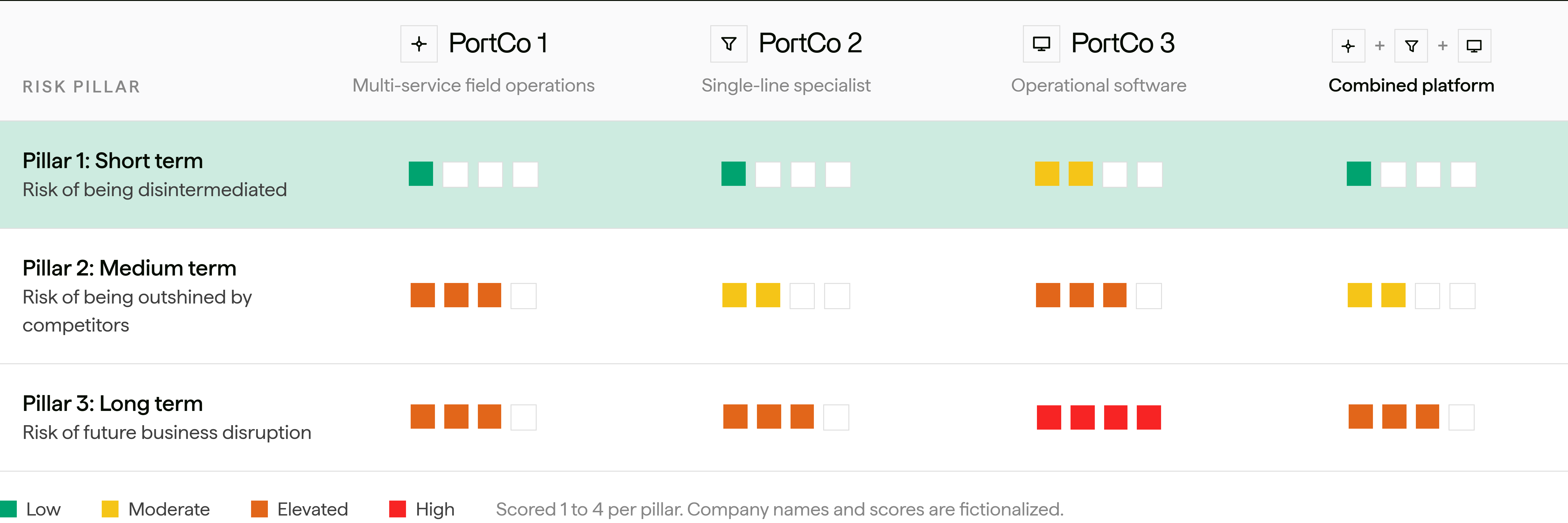
The businesses most exposed to disintermediation are frequently the ones best positioned to do the disintermediating, because they already hold the operating data and customer relationships an entrant has to build from nothing. That advantage has a shelf life, and it expires quietly.
Short-term risk often comes back low, because established service lines and years of operating data are hard to displace quickly. The same assessment then shows no dedicated AI strategy, capability rented from partners, and a data foundation that cannot support the roadmap. Low short-term risk measures the runway, and the runway is finite.
We run this assessment with private equity firms, on portcos and on acquisition targets during diligence.
We map the product suites and capabilities, score exposure across competitors, defensibility, and vulnerability on all three horizons, and come out with a prioritized set of AI initiatives that turn the threats into competitive assets. Then we stay embedded to build them, so the assessment becomes a plan and the plan becomes production.
Knowing where a portco is vulnerable is worth something on its own. Acting on it before a competitor does is worth considerably more.
.png)

We're offering $50K in funding for PE-backed businesses investing in AI innovation. Here's how it works:
This is the third post in a series on AI value creation across the private equity portfolio.