
AI coding agents are breaking out of read-only sandboxes and taking on real operational permissions. They can alter users, grant roles, and execute administrative actions on production data. That isn’t a security oversight—it’s the exact capability required for an enterprise agent like Snowflake CoCo (formerly Cortex Code) to deliver actual value beyond basic auto-complete.
Giving an agent root-like operational permissions brings immediate risk. Unlike traditional deterministic software, AI agents process unstructured inputs, execute semi-autonomously, and interpret instructions through probabilistic models. When an autonomous entity has write access to your environment, the threat surface changes fundamentally:
Addressing these risks requires moving beyond ad-hoc security patches toward clear enterprise standards and best practices. AI governance cannot rely on tribal knowledge or passive policy documents; it requires structural boundaries embedded directly into execution pipelines. Industry standards like the NIST AI Risk Management Framework (AI RMF) and emerging EU AI Act requirements explicitly demand that high-risk AI operations deploy enforceable risk controls, continuous auditability, and fail-safe containment mechanisms.
Snowflake’s reference application, CoCo Control Hub, addresses this directly. Beyond its utility as a management application, it provides a blueprint for operationalizing these exact governance standards. Control Hub offers a concrete architectural pattern for governing any AI agent that requires elevated privileges.
CoCo Control Hub is a 10-page application built natively using Streamlit-in-Snowflake. It operates entirely within Snowflake's perimeter, requiring no external services or external credential management, and can be deployed in under 30 minutes.
It gives platform teams a centralized control plane to handle:
For organizations tracking Cortex Code, Control Hub acts as the missing control layer. As agents move toward autonomous execution and scheduled cloud-based workflows, Control Hub provides the structural boundary required for platform oversight.
The core value of Control Hub is not its user interface; it is its authorization model.
Streamlit apps in Snowflake can execute using owner's rights. In this model, every SQL statement issued by the application runs under the security context of the app's owner role (typically ACCOUNTADMIN), rather than the role of the individual user interacting with the UI.
[ Unprivileged Developer ]
            │
            ▼ (Requests action in UI)
[ Streamlit App (Owner's Rights) ]
            │
            ▼ (Validates request & business logic)
[ Stored Procedure (`ACCOUNTADMIN` Context) ]
            │
            ├──────► [ Executes Action (e.g., ALTER USER) ]
            │
            └──────► [ Writes to Immutable Audit Log Table ]
This pattern decouples user privilege from execution privilege:
The user never holds administrative privileges directly, but the app safely completes the action on their behalf. This pattern scales beyond CoCo to any governance system that requires unprivileged users to trigger gated, high-privilege operations.
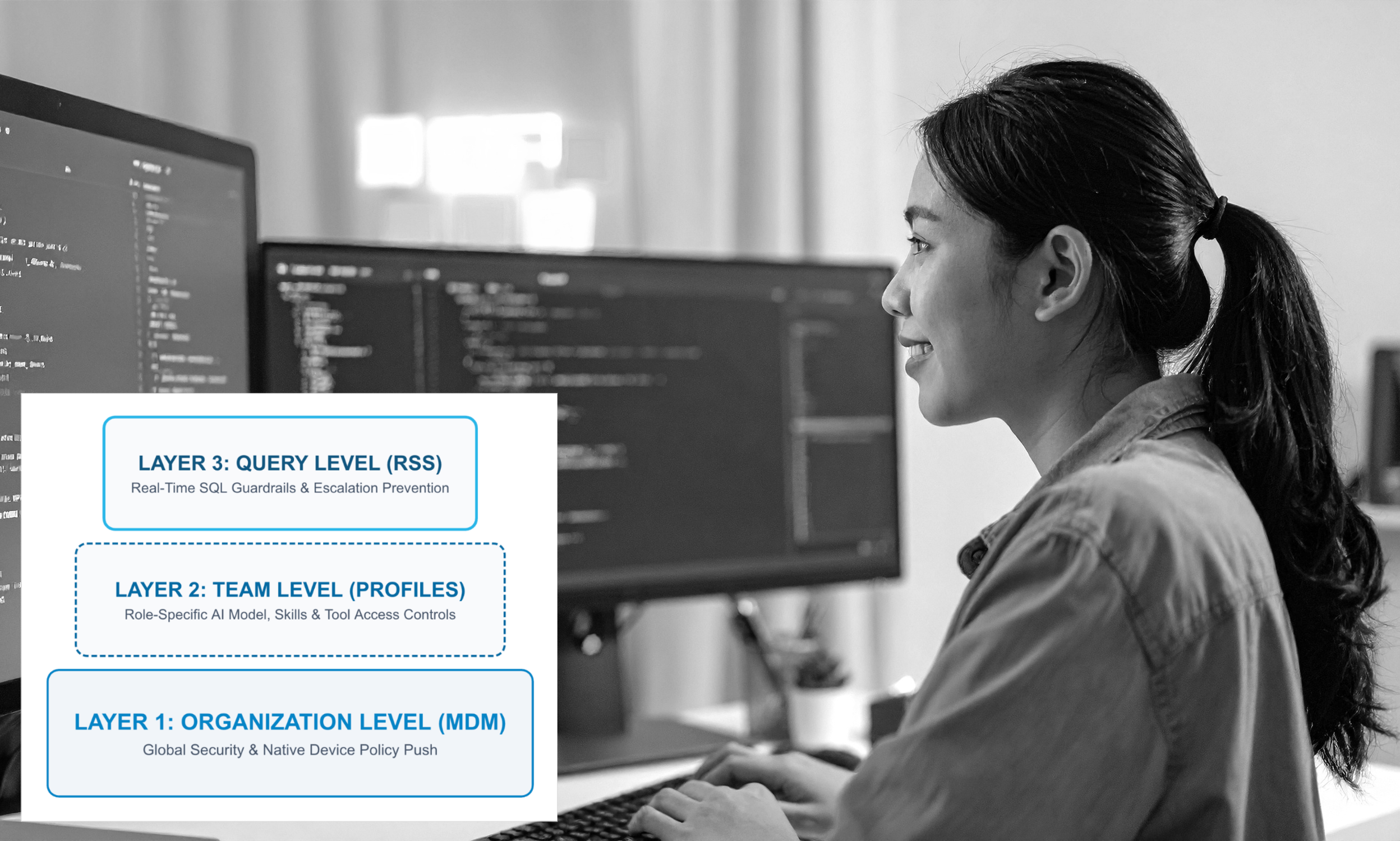
Control Hub reflects a broader shift toward multi-layered governance in Snowflake. Governance controls for Cortex Code now span multiple tiers:
This structural isolation is necessary. Recent security research—such as prompt injection vulnerabilities where malicious files attempt to execute context-aware commands under a user's local credentials—highlights that input filtering alone is insufficient.
System security cannot rely solely on managing what an LLM says. Security architecture must control what context an agent can ingest and restrict what its underlying execution layer is permitted to execute. Combining scoped execution roles with immutable request logging ensures that if an agent acts unexpectedly, its scope of impact is limited and fully traceable.
Governance applied after an agent is in production typically fails. Effective governance must be developed, deployed, and function within the infrastructure in which the agent operates, rather than a policy document existing alongside it.
This aligns directly with framework standards like the NIST AI RMF and the EU AI Act: controls must be structural and programmatically enforced.
Budgets, permission boundaries, and execution logs are not compliance checkboxes; they are the foundational prerequisites that allow an enterprise to safely grant agents operational access in production environments.
Evaluating AI agent security requires moving past asking what an agent can do, and defining how its actions are contained, logged, and audited when it operates. Snowflake has open-sourced the CoCo Control Hub source code and quickstart documentation, providing a reference implementation for teams building enterprise AI control planes.
OneSix helps data and platform teams build the controls that make agent access defensible: scoped execution roles, hard budget limits, and audit trails that hold up under review. Our governance practice works alongside Snowflake teams to implement these patterns in production environments.
.avif)