
Generative AI is walking a path I’ve seen before. I spent years helping companies stand up data visualization tools, coaching teams through adoption and helping them evolve past the potential mess that came with it. Nearly every organization made the same mistakes in the same order. Generative AI is following that same path almost step for step right now, and the solution to reach maturity is a tried and true pattern.
I believe the data value chain is cyclical. Each newly discovered or created capability moves through the same maturity cycle, and I believe we are hitting an inflection point in that cycle with generative AI. The clearest corollary I have lived through is data visualization.
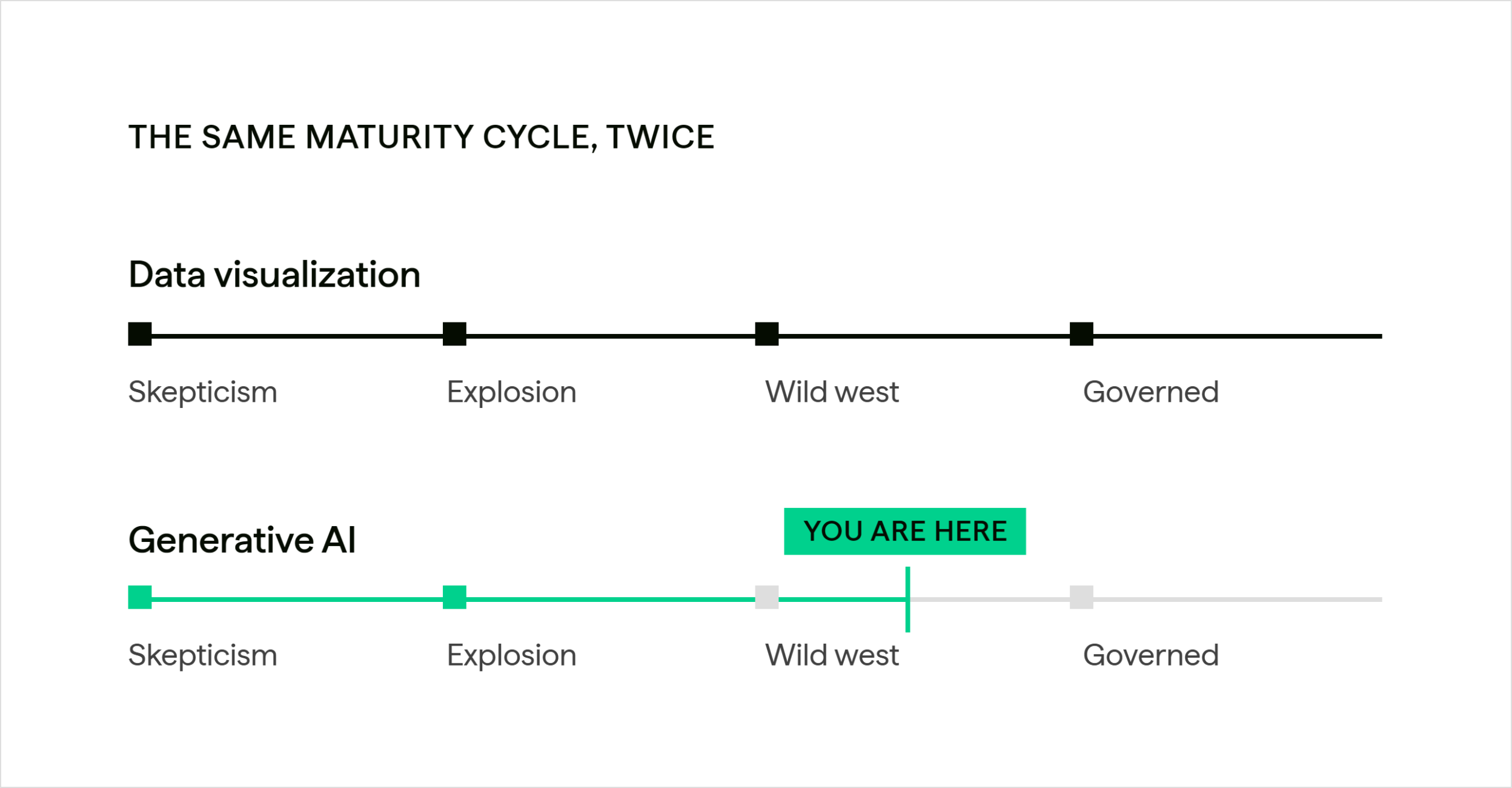
Fifteen years ago, when tools like Tableau and Power BI were just coming to market, the first step in adoption was users understanding and accepting the value of the product. The common question was, “I can look at my data with my Excel extracts, why would I need a fancy tool that shows me pictures?”
Organizations quickly saw that visualizing data helped get to insights faster, and in many cases surfaced insights that were not easily found when looking at tens or hundreds of thousands of rows in Excel. Once people realized this value, the creation of data visualizations exploded across organizations. The value was tangible. People answered business questions faster and were able to take action on those insights to improve their business.
This came at a cost. Insight creation turned into a lawless, wild west landscape, where people could leverage visualization tools to create their own business definitions, or, worse, misunderstand existing data to come up with wrong answers to their questions. The only thing worse than no answer is a wrong answer, because it gives people a false sense of security and confidence to make decisions off of inaccurate information.
The answer to this was not to squash the empowerment of end users by removing access. It was to guide them to build dashboards responsibly. Creating processes that defined certified and blessed insights, while still preserving the ability for people to quickly experiment, refine, and ultimately submit for broad adoption, was critical to striking a balance between the speed and the precision of insight discovery.
Many organizations have now empowered their teams with an incredible new superpower: leveraging generative AI to build new things fast. And it truly feels like a superpower. You can talk to a machine, and it will build whatever you want, without the need for you to have any knowledge of how it does that.
Allowing people access to this new superpower can create risk, and in the spirit of my favorite superhero, “With great power comes great responsibility.” To mitigate this risk, organizations can create governed processes and controls upon a foundation of data. This will then empower your people to build insights they can trust and act upon with real impact for the business.
The stakes are higher this time with generative AI. Data visualization democratized how people presented data. Generative AI democratizes how people create logic and definitions, which is a deeper and more consequential layer. A rogue dashboard shows a wrong number to whoever opens it. A rogue AI-generated definition can get embedded into a workflow, an agent, or another application and propagate quietly across the business long after anyone remembers where it came from. It is the same shape of problem, with meaningfully higher stakes. And this time there is less friction to slow it down, because generating that logic no longer requires someone who knew how to build it by hand.
The dangerous version of this is when analysts have carte blanche to pull their data from anywhere, create their own business rules that may already be defined and certified by the organization, and create siloed or rogue definitions that are redundant or contradictory to these certified definitions. Knowing those definitions are now being created by AI, we want to govern the accuracy and the method of applying them, so they are easy to maintain across the org.
The solution is to build a trusted, governed, and certified data warehouse that people can direct AI to draw from as a safe starting point for their creative and personalized AI solutions. Tools like Snowflake allow for fast and trusted generation of these insights while still leveraging naturally supported capabilities: CoCo (formerly Cortex Code) for fast, reliable generation, Horizon Catalog to define and hold business definitions, and easily built interfaces like Snowflake CoWork for users to gain insights with natural language. The certified foundation and the tools that build on it live in the same governed ecosystem, so speed does not cost you consistency.
Building this foundation is also faster than it used to be, because the same generative capabilities can be leveraged in the data warehouse build. AI accelerates the modeling, the pipeline development, and the application of business-supplied rules, so establishing a trusted foundation is no longer the multi-year effort it once was. The business creates the logic, and the AI saves enormous amounts of time implementing it through code.
This is also where the deeper architecture pays off. A certified warehouse is where data and cloud architectures come together. The raw, cleansed, and modeled structure underneath gives generated code a trusted pattern to query instead of dirty or conflicting source data, and an elastic cloud platform makes it economical to build and run these solutions without managing a bloated and inefficient infrastructure.
There is a data security benefit here as well. When creation happens against the certified warehouse, your existing access controls come along automatically. A person building AI insights or products on the certified warehouse can only leverage what they are already allowed to see. Empowerment stops being a data-leak risk, because the same rules that protect your data protect everything built on top of it, no matter who built it or how fast.
Building these certified environments should not get in the way of innovation. There still needs to be an empowerment of teammates to be as creative as possible in their explorations and experiments. If the warehouse has all the data needed to support an idea, go all in on it. If the warehouse has gaps, or the idea calls for net new data sources, create an experimentation environment where people can try, fail, try again, and craft fast, innovative solutions to problems the business has never solved before.
Then create a process that empowers teams to review, approve, and scale their newfound capabilities, turning their ideas into full blown products that make their business and their teams better. That review-and-scale process is where data governance does its best work. Data governance is not designed to create bureaucracy or unnecessary gates. Rather, it should create workflows that let people experiment with speed and then apply what they build responsibly at scale.
Every new capability moves through the same maturity cycle. First people question whether it is worth adopting at all. Then the value becomes obvious and creation explodes across the organization. Then that explosion outpaces any guardrails, and you end up in the wild west, where speed has quietly cost you trust. The organizations that come through it are the ones that add governance without smothering the empowerment that made the capability valuable in the first place. Generative AI is moving through that exact cycle right now, and most organizations are somewhere in the middle of it.
Whatever the data consumption capability of the moment happens to be, the foundation underneath it is what lasts. It is what keeps alignment, consistency, and trust in information across an organization, no matter how many times the tools and interfaces on top of it change. That is a layer worth investing in, because it propagates trust forward to every consumption layer after it.
So take a step back and take inventory of where your organization actually sits in this maturity cycle. Four questions are a good place to start.
We have the benefit of hindsight in supporting the maturity of generative AI. We have watched the visualization cycle play out, and we know the answer is in finding the balance between speed and accuracy. The solution is to build a trusted foundation while giving people a real place to create. The organizations that learn from history quickly will create highly trusted and impactful solutions with their teams.