Value only counts if it holds up when a buyer inspects it.
Every post in this series has been building toward one moment. The AI thesis goes into the plan, the valuation story gets built, the exposure gets mapped, the spend gets classified. Then a buyer's diligence team opens the data room and asks to see how it all works.
That moment has gotten harder. Buyers now diligence AI the way they diligence revenue quality or customer concentration: with specialists, specific document requests, and deal terms tied to what they find. An agent that works but can't be traced, explained, or run without the people who built it reads as risk, and risk gets priced as a discount.
Most sponsors aren't ready for that conversation. In a 2026 Grant Thornton survey, 9% of PE firms said they were confident they could pass an independent audit of their AI governance within 90 days, against 22% across all industries.
The foundations that survive diligence are the same ones that let a portco team run the system after handoff. Build them during the hold and they do both jobs.
What buyers ask now
The questions have converged, and they land in the purchase agreement as much as the data room.
Lawyers advising buyers now recommend AI-specific reps on rights to training data, accuracy of disclosures about model performance, and the absence of undisclosed third-party dependencies, sometimes treated as fundamental reps with longer survival and higher caps. They recommend escrows against post-close data-rights problems and indemnities for noncompliant training. R&W insurers are scrutinizing AI too, which can mean exclusions that push the risk back onto the seller.
Regulation adds a clock. The EU agreed in May 2026 to move its high-risk AI obligations to December 2027. For a portco with European customers, that falls inside the next owner's first years, which is exactly the period they're underwriting.
Strip away the legal language and the diligence comes down to four foundations.
Data ownership and access control
The first question is whether the company has the right to use its data the way the agent uses it. The second is who the agent acts as.
Ownership. Earlier in this series we argued that proprietary data is what makes AI defensible. That advantage is only an asset if the company can prove it owns it. Buyers trace provenance: which sources feed the agent, what customer contracts permit, and whether one customer's data is kept separate from another's or sent to train an outside model. A portco that can't answer those questions has a data advantage nobody will pay for.
Definitions. Agents act on business definitions: what counts as an active customer, how revenue is recognized, which margin is the real one. A definition an agent invented, or an analyst generated on the fly, can spread into every workflow it touches. Buyers want to see those definitions held in a governed catalog, owned by someone, and applied the same way everywhere.
Access. Agents act with credentials, and the credentials tell a buyer a lot. An agent running under a shared service account or a former employee's login is a finding. What holds up:
- Each agent has its own identity, scoped to the least access the task needs
- The agent inherits the data platform's existing role-based access and masking policies rather than working around them
- Every read, write, and action is logged against that identity
Building on a certified data platform gets most of this for free: anyone building on it can only use what they're already allowed to see. For agents with real operational permissions, separate who asks from who executes. In the CoCo Control Hub pattern on Snowflake, a user requests an action, a validated procedure runs it under a separate execution role, and the audit record is written automatically. Nobody holds admin rights directly, and every approved action is still traceable.
Quality monitoring
An agent that worked at launch can quietly stop working. Source data changes, an upstream schema shifts, the model provider ships a new version. None of it throws an error. The answers just get worse.
Buyers know this, which is why a demo doesn't satisfy them. Their advisors red-team models and test edge cases. The strongest answer is a record showing the company has been doing that itself since day one:
- Data quality checks on every pipeline that feeds the agent, with alerts when inputs break
- An evaluation set of real cases, run on every change to prompts, models, or data, with the results kept
- Production metrics tracked from launch: accuracy, escalation rate, time saved, and cost per task
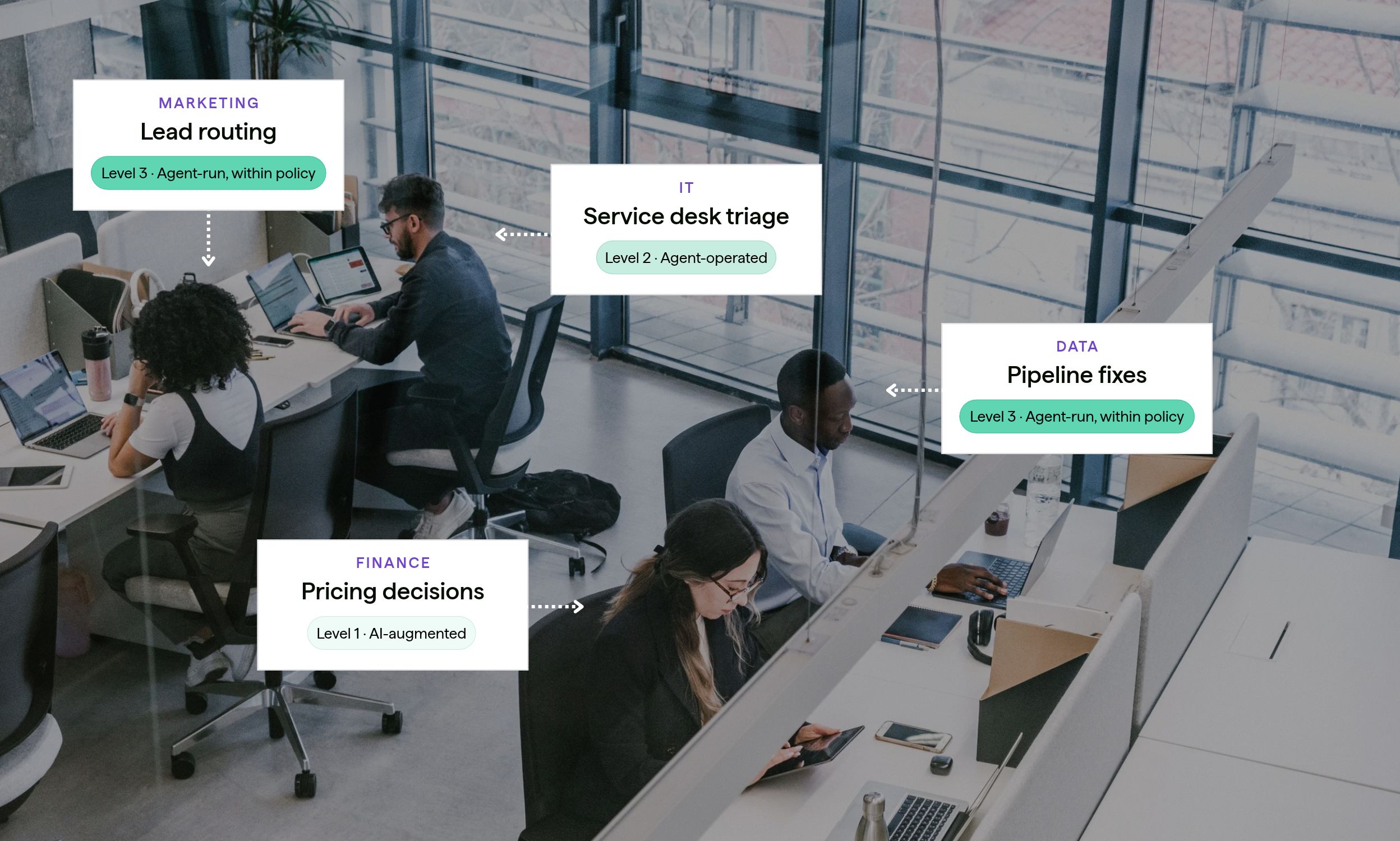
The most persuasive record is one most portcos don't keep: every agent proposal counted as accepted, edited, or rejected. In our AI-native enterprise framework, that record is how work earns autonomy, moving from human-approved to agent-run only when the acceptance data supports it. A buyer reading it can see which work the agent handles alone, which still needs a person, and why. Autonomy granted on enthusiasm, with no record behind it, is the version that gets discounted.
That record does double duty. It's the seasoned, run-rate evidence buyers want behind a valuation story, and it's how the portco team will know when something needs fixing after the people who built it are gone.
Policy enforcement
A written AI policy answers the first diligence question. The follow-up is where that policy is enforced. The answer that holds up is that governance lives below the agent: permissions enforced in the systems around it, so the rules hold even when the model gets something wrong.
Agents act, which raises the stakes over a dashboard or a report. An agent that issues refunds, changes a schedule, or emails a customer needs rules it can't talk its way around. In practice that looks like:
- Approval thresholds. A refund over a set amount, or any change to a contract, routes to a named approver before it executes. Anything that reaches a customer or production has a person's name on record.
- Data handling. Sensitive fields are masked or redacted before they reach a model.
- Guardrails and limits. The agent can only call the tools and systems its task requires, with a way to shut it off fast.
- Spend limits. Credit budgets by team and limits on which models each role can call, so a retry loop can't turn into a cloud bill.
- An audit trail. Every action, every human override, and every policy block is logged and searchable.
The test is simple. Pick any rule in the policy document and ask where it lives in the code. If nobody can show you, a buyer will assume it doesn't.
Documented assets
A buyer is paying for what transfers at close. Documentation is what makes an agent transferable.
That means everything the agent depends on lives in version control with a clear history:
- Pipelines that feed it, with lineage from source system to output
- Models and prompts, including which version is in production and why it changed
- Workflows and tool connections, so someone new can see what the agent does, in what order, with what permissions
- Evaluation sets and results, so a change can be tested against what came before
- Context: the conventions, definitions, and business rules the agent relies on, written down where agents can read them and versioned like code
Keep all of it in systems the portco owns. Context, policy, and records should live in the company's own platform, with agents replaceable. A buyer acquiring an agent whose logic sits inside a vendor's product is acquiring that vendor's roadmap.
Inventory the AI you didn't build, too. AI embedded in third-party software, what our governance team calls shadow AI, is exactly what the "no undisclosed third-party dependencies" rep is written to catch.
The same records do work beyond diligence. In the last post we argued that the capitalization treatment that survives a quality of earnings review is the one the company can document: a real authorization date, defined performance criteria, and build costs separated from run costs. A portco that documents its AI assets well gets both arguments for the price of one.
Operable after handoff
The hardest diligence question is also the simplest: can this company run its AI without the people who built it?
Buyers assess whether key know-how depends on a few individuals, and some write covenants requiring the seller to retain key AI engineers through close. Both are signs of a dependency being priced. An agent that keeps working only because one engineer, or one outside firm, watches it every day is a liability the buyer inherits.
That includes us. An AI partner that leaves a portco dependent on it has made the asset worth less.
Operable means the roles exist inside the portco: an owner accountable for each agent's results, someone who manages its instructions and tests, reviewers whose decisions feed the acceptance record, and platform engineers who run it the way IT runs email.
A practical test for handoff readiness. Can the portco team, on its own:
- Change a business rule and ship it?
- Swap or upgrade the underlying model and confirm nothing broke?
- Find and fix a failed pipeline from the runbook?
- Tell the board what the agent costs to run each month?
Four yeses and the buyer is acquiring a capability. Fewer, and they're acquiring a project.
The premium is engineered
None of these foundations is exciting, and none of them shows up in a demo. They are what separate an AI initiative a buyer will pay for from one they discount.
The timing matters for the same reason it did in the first post. These foundations take time to build and longer to accumulate a track record, and evidence assembled in the months before a sale reads that way to a buyer. Retrofitting rarely works anyway: governance applied after an agent is in production typically fails. Built into the work from the start of the hold, they turn AI into a premium at exit. Bolted on at the end, they turn it into a line in the risk section of the QofE.
Where OneSix comes in
We build agentic AI for PE-backed portcos with diligence in mind from the first sprint, through forward-deployed engineering pods that design the work before automating it.
That means agents that run inside the portco's existing data platform and access controls, with evaluation and monitoring in place before go-live, policies enforced in the system, and every pipeline, model, and workflow documented as it's built. Then we hand it to the portco team and make sure they can run it, because the asset is worth more when it doesn't need us.


Nominate a portco for $50K in AI funding
We're offering $50K in funding for PE-backed businesses investing in AI innovation. Here's how it works:
- Nomination. Interested firms nominate their portco(s) for funding.
- Assessment. Qualified companies receive a brief AI fit assessment.
- Investment. Selected companies receive $50K toward an AI innovation engagement.
Keep reading: The PE AI field guide series
This is the fourth post in a series on AI value creation across the private equity portfolio.
- AI Is a Lever: Every PE Value Creation Plan Needs an AI Thesis
- Is AI Adding to Your Portco's Exit Valuation?
- The Disintermediation Risk: Where Is Your Portco Vulnerable to AI?
- CapEx or OpEx? The Agentic AI Question Splitting PE Boardrooms
- -> AI Agents That Survive Private Equity Diligence
- One Playbook, Every Portco: Scaling Agentic AI Across the Portfolio