
Most marketing reports tell you what happened. We build Media Mix Modeling, Multi-Touch Attribution, and Campaign Intelligence systems that measure channel impact and optimize where the next budget goes.
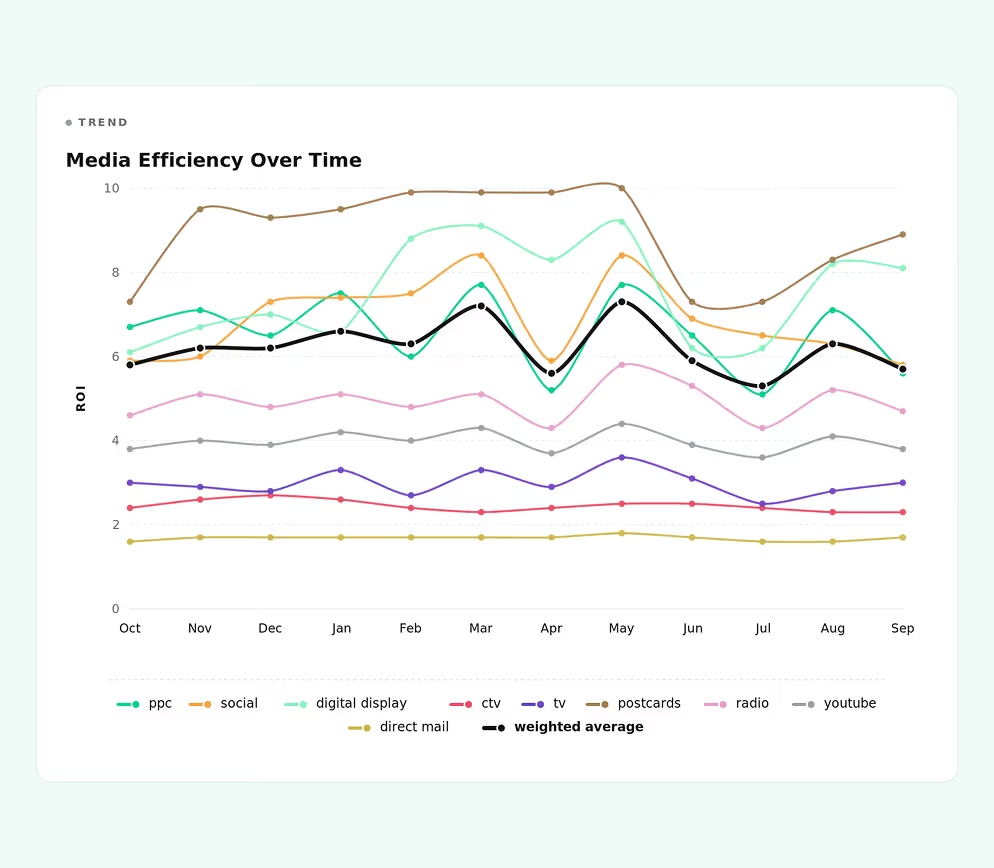
Custom media mix modeling pipeline that measures every channel against revenue.
CHALLENGES
The complexity of modern media has outpaced spreadsheet attribution and dashboard metrics. The signal arrives too late, ignores offline spend, or doesn't hold up when leadership asks how it was calculated.
Click-based models overweight the final interaction and ignore offline channels, brand spend, and long-term effects.
Channels that drive real growth get underfunded while spend that looks good in a dashboard keeps getting renewed.
Marketing leadership can't defend budget allocation decisions because the measurement doesn't hold up to scrutiny.
User-level tracking is becoming harder to rely on at scale, making traditional attribution models less reliable over time.
Approach
We build marketing measurement and optimization systems, combining Bayesian Media Mix Modeling, Multi-Touch Attribution, and Campaign Intelligence to quantify the contribution of every channel to business outcomes.
01
Data collection, preparation, and source system integration
02
Model development, calibration, and validation against historical outcomes
03
Budget allocation and scenario planning tools with calibrated uncertainty
04
MLOps infrastructure that refreshes models as market conditions and media mix shift

The output is a system your team uses every budget cycle to test incrementality and optimize where the next dollar goes, along with the modeling and MLOps practices that make every subsequent refresh faster to ship.
Applications
Variant
Built for
Variant
Built for
Marketing and revenue teams measuring channel impact and optimizing spend across paid, owned, and earned media
Variant
Built for
Higher Education teams measuring recruitment marketing impact and optimizing spend against enrollment outcomes
Variant
Built for
Higher Education advancement teams measuring what drives donor engagement and optimizing outreach to grow giving
Variant
Built for
Healthcare and life sciences teams measuring HCP and patient marketing impact and optimizing spend across channels
Accelerator
For organizations whose MMM needs outgrow off-the-shelf tools, we deploy the Media Mix Modeling Accelerator, a production-ready Bayesian MMM system built on numpyro and OneSix's in-house modeling framework.
What's included
A numpyro-based framework that estimates channel effects, adstocking, saturation, and seasonality in a single Bayesian inference pass, with full posteriors on every parameter.
Grouped effects across regions, stores, or business units, with non-marketing covariates modeled inside the inference. Handles uneven cadences without manual alignment.
Recommended budget reallocations subject to real-world constraints. ROI with uncertainty bands and current-vs-recommended comparisons built for marketing stakeholders.
A recurring pipeline connected to your data and BI layer, with periodic retraining. For journey-level measurement alongside the macro view, we deliver MTA as an explainability-based framework.
Process
01
Data audit, channel inventory, and outcome definition
02
Model specification, calibration, and Bayesian inference
03
Backtesting against historical outcomes and uncertainty calibration
04
Production pipeline, BI integration, and recurring refresh cadence
FAQs


Each answers a different question. Media Mix Modeling quantifies the macro contribution of every channel, including offline and brand, to a business outcome and produces recommended budget allocations. Multi-Touch Attribution measures how channels interact along individual customer journeys and works best for digital, user-level data. Campaign Intelligence measures the performance of specific campaigns, creative, and audiences. Most engagements combine more than one.
It depends on the approach. MMM typically requires two to three years of weekly or daily spend and outcome data plus non-marketing covariates. MTA needs digital event-level data with enough volume to identify channel interactions. Campaign Intelligence works on campaign-level performance data, often available within months. We assess what you have during scoping and design the model around it.
Most clients refresh monthly or quarterly as new spend and outcome data arrive. The pipeline is configured for periodic retraining as part of deployment, so refreshes happen on a schedule rather than requiring a custom rerun each time.
Each approach reports uncertainty differently. Bayesian MMM produces posterior distributions on every parameter, so output is a range with calibrated uncertainty. MTA produces journey-level attributions with confidence based on data volume. Campaign Intelligence reports performance with statistical significance. Across all three, we benchmark against holdout windows, lift tests, and incrementality experiments where available, and report results in terms relevant to budget decisions.
Outputs are integrated into your existing BI layer (Tableau, Power BI, Sigma, Looker) and operational systems (CRM, ad platforms, marketing automation), so budget recommendations, attribution scores, and campaign signals reach decision-makers at the moment they need them. Integration is engineered into the build from scoping forward.